AI / Models / Agents
Live Training Run · BrushArena: BrushArena’s live training page.
Introducing Julia 1 | Supersonic Labs: Supersonic Labs’ official introduction to Julia 1.
Introducing Claude Sonnet 5.5 | Anthropic: Anthropic introduces Sonnet 5.5’s improvements in coding, knowledge work, and running costs.
Introducing GPT-6.1 Sol | OpenAI: OpenAI introduces GPT-6.1 Sol and its updates in coding, computer use, and professional tasks.
Exploring Similarity Search with Prompted Subspaces — Jasper Lu: Uses text prompts to construct concept subspaces for image similarity search by color, style, or meaning.
RL is an evolutionary algorithm: Discusses reinforcement learning through the lens of evolutionary algorithms.
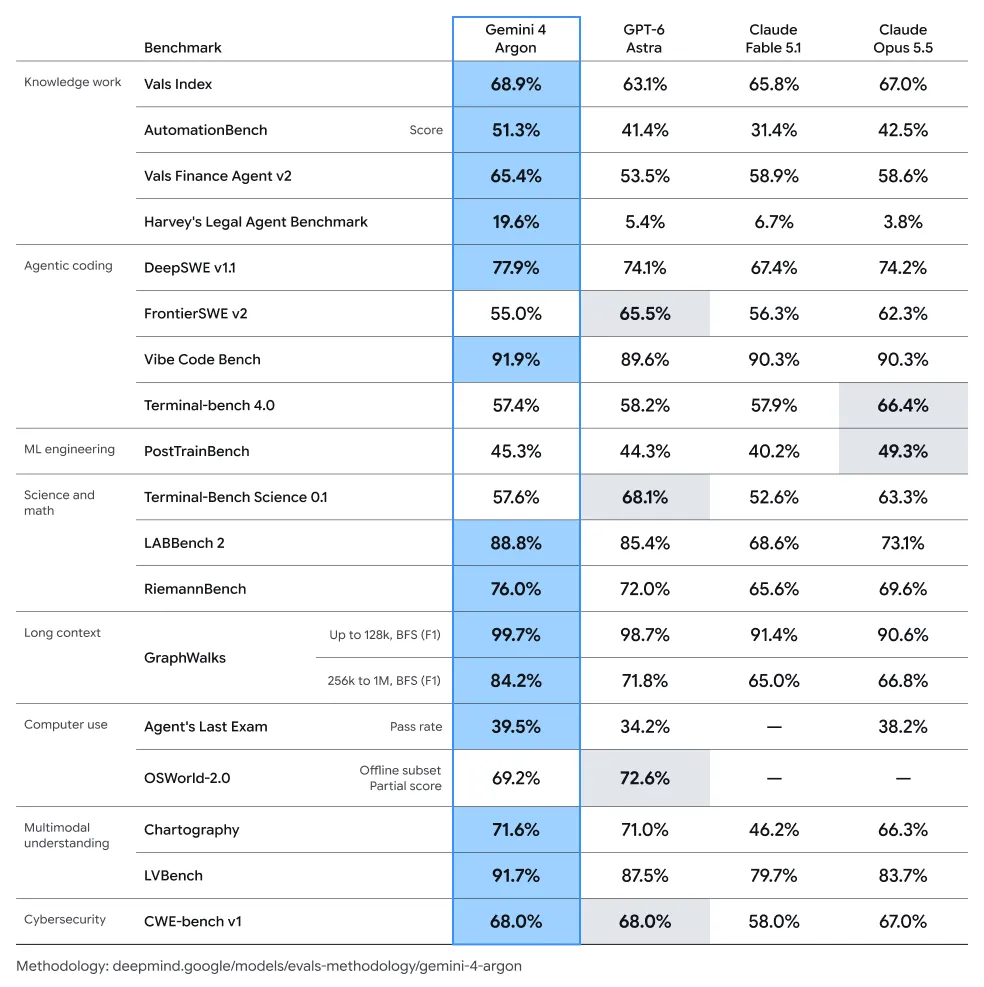
Introducing Gemini 4: Google introduces Gemini 4 Argon with an output limit of one million tokens, initially rolling out to trusted cyber defenders and testers.
ExplorationBench: Evaluates autonomous exploration in unfamiliar programming and logic environments, using interpreters and proof checkers to verify results.
Grokipedia: The Grokipedia homepage.
Cogentic: The Cogentic project homepage.
How many AI agents could we run? | Epoch AI: Estimates that high-bandwidth memory shipped in 2025–2027, fully deployed and allocated to the relevant workloads, could support nonstop agents providing weekly working hours equivalent to roughly 140–720 million full-time employees.
AI chips shipped through 2027 could run tens to hundreds of millions of concurrent frontier-model agents. Running nonstop, these agents would supply as many weekly working hours as about 140–720 million full-time employees.
A model guide for the GPT-6 family | OpenAI: A guide to model selection, instructions, context and cost management, long tasks, and production deployment with the GPT-6 family.
Lessons from building an automated research scaffold — LessWrong: Shares lessons from an automated research scaffold: limited productivity gains, alongside failures involving reward gaming, result interpretation, and audit monitoring.
What if automating AI R&D triggers an intelligence explosion? — CASP: Examines whether automated AI research could trigger an intelligence explosion, its implications, and policy responses, while emphasizing uncertainty.
Tokenization: A Survey for Modern NLP | alphaXiv · PDF: A survey of subword tokenization methods, their limitations, and alternatives in modern natural language processing.
Language Model “Shape” | Alex L. Zhang: Explores designing language-model input and output structures around agent scaffolds.
Mathematics / Research / Learning
synthetic-sciences/openscience: An open-source AI workbench for scientific research.
CSAPP Chinese Reading: A Chinese reading site for Computer Systems: A Programmer’s Perspective.
AGMAI: September 29 Statement: The mathematics advisory group draws on community feedback to recommend practices for publishing AI-generated mathematical results and supporting human understanding and review.
Transformer Explainer: An interactive visualization of GPT-2 small that explains computations inside a Transformer.
AI solves a ‘holy grail’ problem from probability theory | Scientific American: Reports on an Anthropic model’s proposed proof of a percolation continuity conjecture and discusses its implications for mathematics.
Apex Leaderboard: The Apex leaderboard announcement page.
MIT 6.5940 Fall 2026 TinyML and Efficient AI Computing: MIT’s fall 2026 course covering pruning, quantization, model serving, distributed training, and deployment on edge devices.
Expenditure Horizon | METR: Measures optimization ability through the intersection of human and agent cost–benefit curves, with an initial study of NanoGPT optimization.
Solving Open Research Problems Together | Meta AI Research: Describes Muse Spark’s collaboration with mathematicians on open research problems, with results checked by independent mathematicians.
Learning Forever using Artificial Neural Networks: Shibhansh Dohare’s doctoral thesis on loss of plasticity, continual backpropagation, and policy collapse.
Programming / Systems / AI Tools
A shared cache for Cargo builds | mr boxington: A shared Cargo build cache that reduces repeated compilation.
deepseek-ai/DeepGEMM-Ascend: A matrix multiplication kernel library for Huawei Ascend processors.
Introducing cf | Cloudflare: Cloudflare introduces an agent-oriented command-line tool for its full API.
Ely · GPUI components: A showcase of GPUI components.
claude.dev: A technical blog for developers building with Claude.
MonoCode: A graphical interface for multiple coding agents.
MyGo: A Go framework for desktop apps with web frontends or native interfaces.
Pi 1.0 | Earendil: Introduces Pi 1.0, an extensible agent framework.
Comma: A continuously running agent for personal tasks.
Lorca: Runs AI teammates locally to work on files and tasks through individual or group chats.
I’m Using GPUI For Everything | Freek Van der Herten: Recommends a Syntax team video about developing with GPUI.
Design / macOS / Other Finds
mg-chao/snow-apps: The source repository for Snow Shot and Snow Image Viewer.
Cida: Translates and polishes text across Mac apps.
tornikegomareli/omarchy-spaces: Shows app icons for each workspace in the Omarchy bar and supports workspace switching.
Pal-AI-Lab/Coopanion: Coo is a desktop companion at the bottom of the screen, supporting chat, voice, and authorized computer use.
The Making of Cursor’s Icons | Minor Adventures: Shares the design process behind Cursor’s icons.
IPPure: Checks IP information, risk, network egress, and leaks.
arXiv: Updated Submission Rate-Limit Policy: arXiv’s official announcement of its updated submission rate-limit policy.
adileo/squirreldisk: A cross-platform disk usage analyzer written in Rust, with sunburst and treemap views.
Yab: yet another browser: The Yab browser homepage.
AI Haotan: Compares prices and stock across marketplaces for AI accounts.
metasequoiaime/msime-windows: The Windows repository for Metasequoia IME, including its input framework, server, interface, and installer.
gillesgoetsch/omacvm: Runs Omarchy in a Mac virtual machine, integrating trackpad gestures, audio, and keyboard behavior.
lxj5820/dsh-boot-animation: Replaces the DSH boot screen with a full-window video that fades into the app.